
Library of Perspectives Pt. 1: Which end of the barbell?
I’m not sure *who* said it first, but creating content today broadly falls into one of two buckets: timely or timeless.
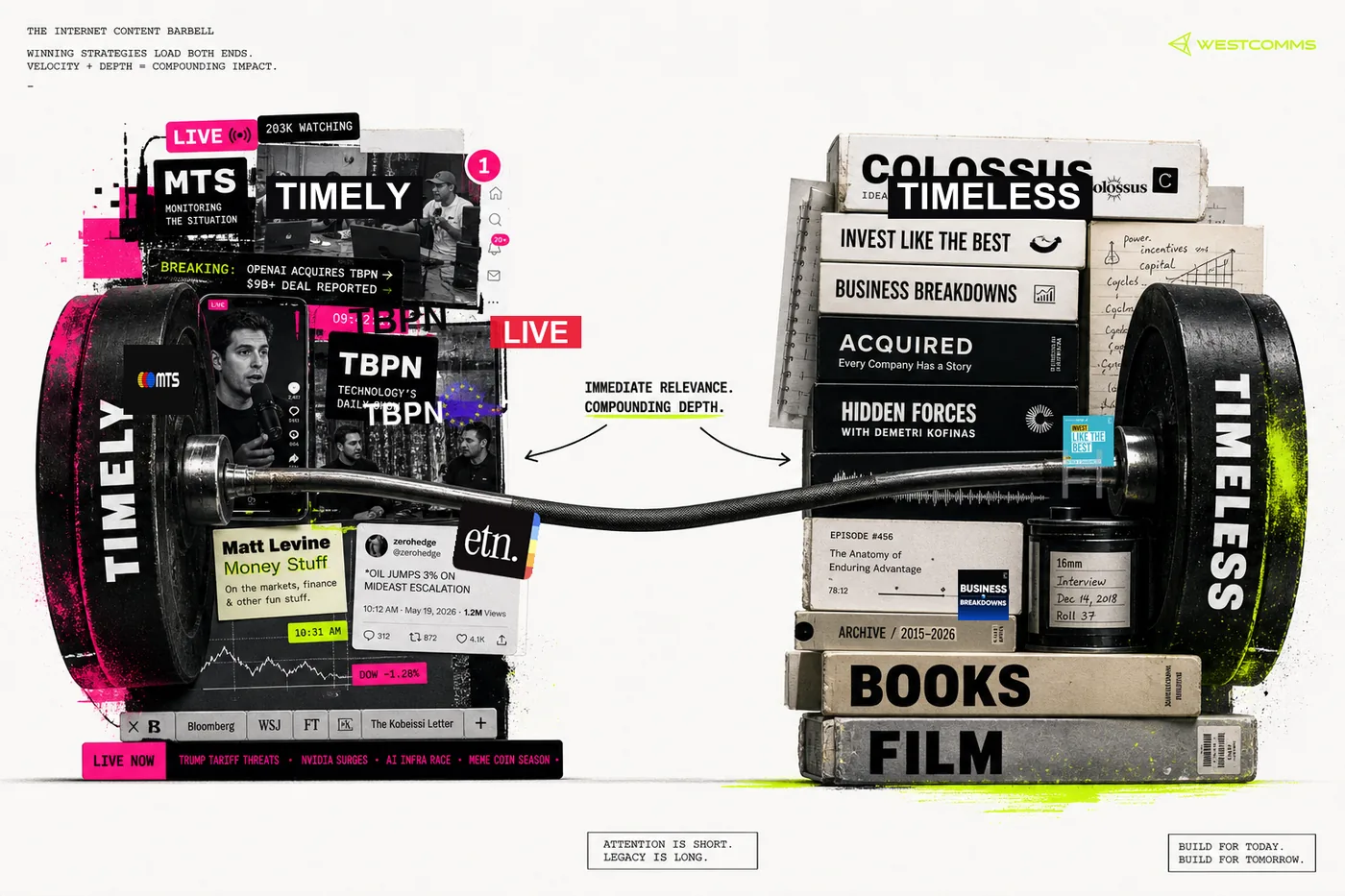
Timely: the clip machine
“Timely” is a bit misleading, because it’s effectively real-time. TBPN, MTS, ETN, and crypto-native shows like 11AMclub (RIP crypto) all dissect what’s going on as it happens, which is impossible to do part-time. The most successful versions of these shows (by FAR this is TBPN) inject as much energy, analysis, and perspective as possible into their streams.
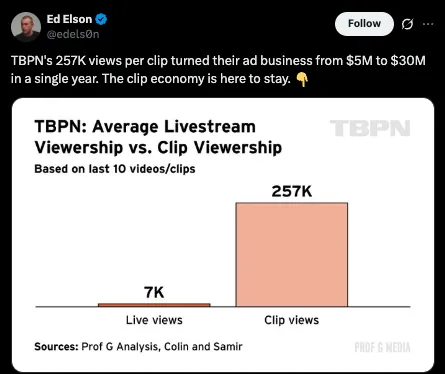
But the trick ISN’T about the streams themselves or people watching it. That’s the common misconception. Ironically, nobody actually watches TBPN live (lol). The hosts will say “the live audience matters more,” but it’s not the business model.
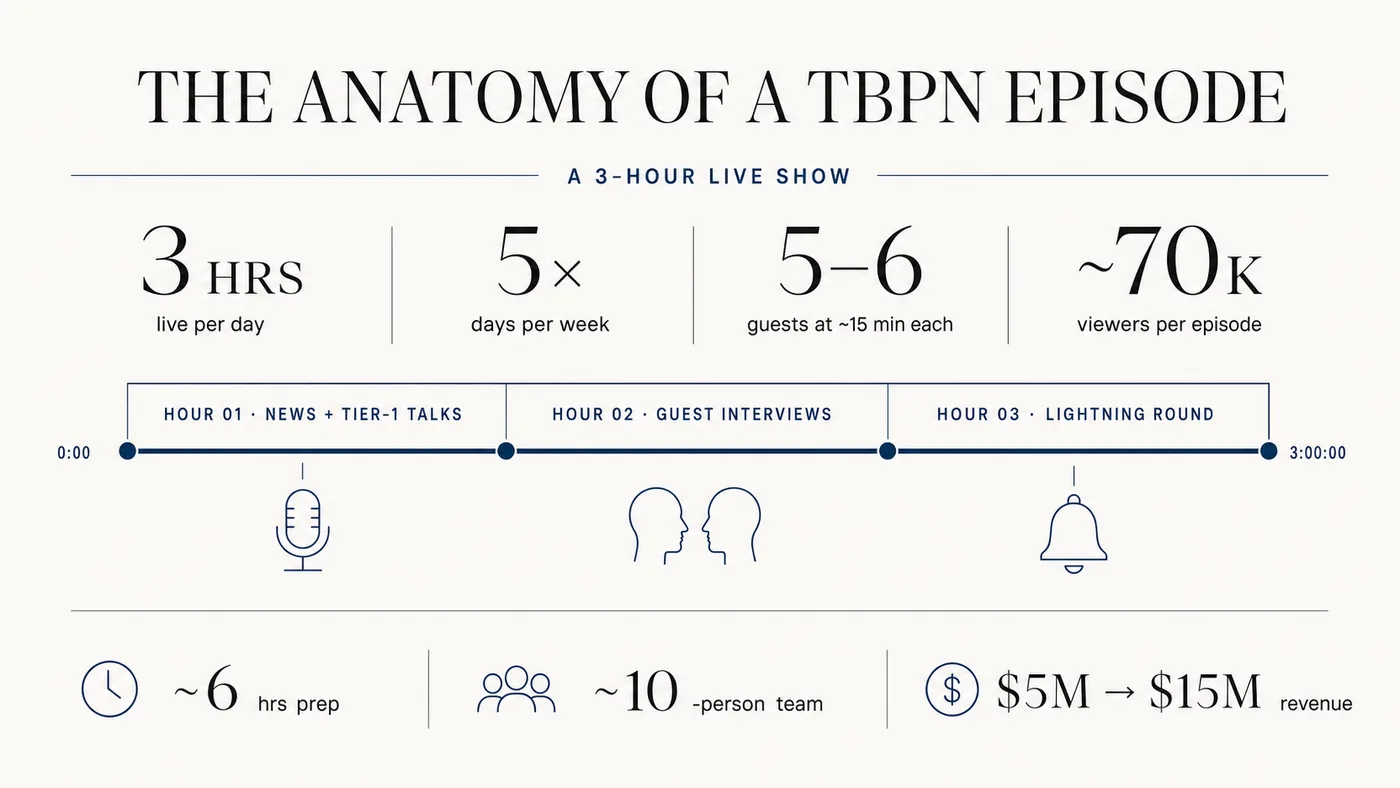
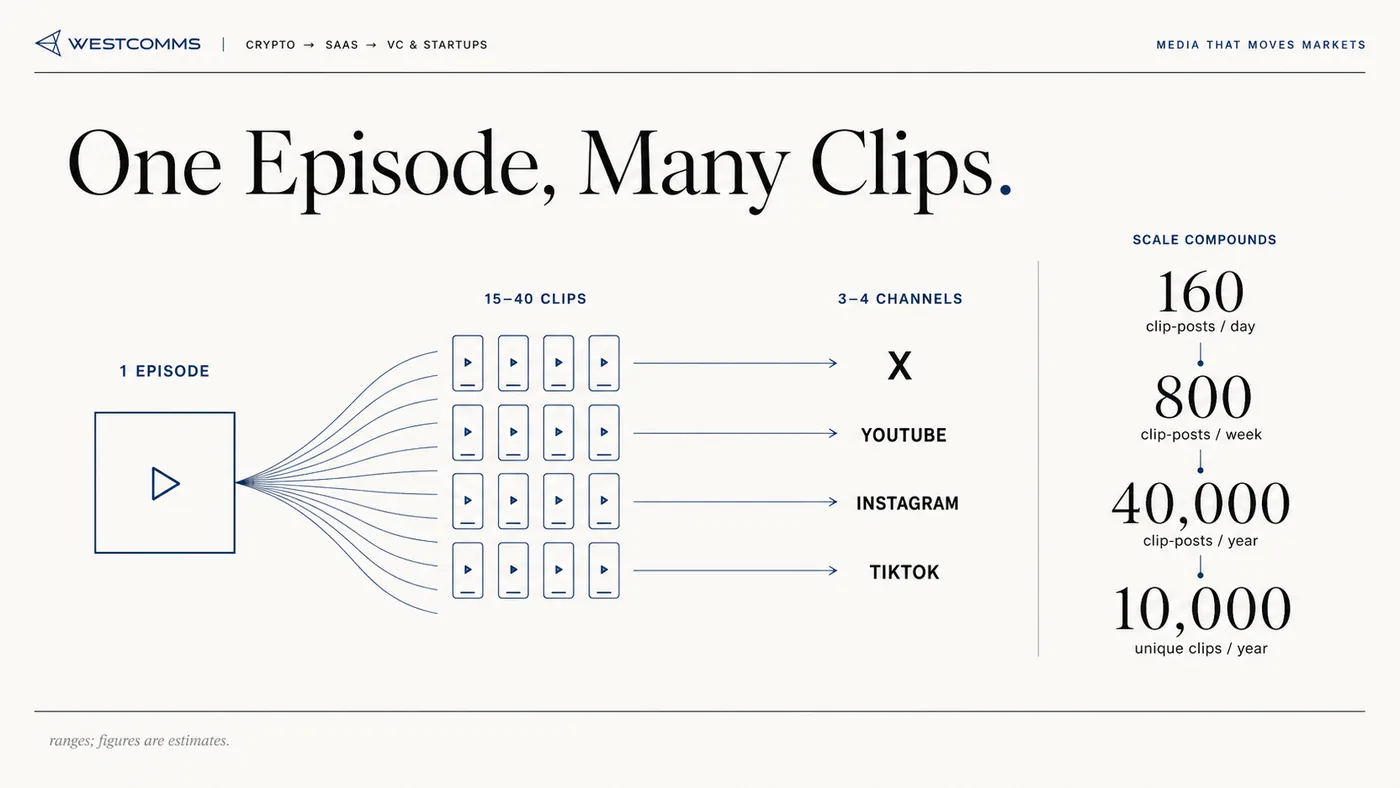
What people do tune into are the clips. High-quality, high production-value, daily livestreams are the table stakes discipline required to succeed, because that’s how you create good clips. Once the day’s stream is recorded, it gets cut up, edited, and post-produced into clips published wherever the audience lives for them to consume whenever they want. And the algorithms obviously love it because they’re fed an enormous amount of content on literally a daily basis.
TBPN in particular also does a spectacular job with ads. They’re just phenomenal.
The clips always include the ad, and the end of the clip breaks instantly into the ad read, no friction whatsoever (and no indiciation of when the clip will finish). The ad read itself is also so smooth that by the time you’ve moved your mouse to pause the clip or close the window or scroll, most of the ad has already been presented. It’s extremely effective. The hosts are also notoriously pro-advertising, and lean into their ads as part of the content itself. Let’s break down the clip math:
Pair this kind of scaled-up, algorithm-optimized, high-quality content with a basic promote-what-works spend strategy and you have engineered the best content machine creativity can produce for the modern day internet.
According to the Wall Street Journal, TBPN went from zero to roughly $5 million in ad revenue in its first year, having only started selling ads in January 2025 (~ 3 months after the show launched and the same month it started recording daily).
For those counting, that's ~$5M in nine months of selling ads. Impressive.
Before getting acquired by OpenAI for a rumored $100M (lol), in 2026 they were targeting $15 million, a 3x jump, and they’d hired someone specifically to drive it.
If the “live audience matters more,” OpenAI wouldn’t have bought the franchise.
---
Timeless: infinitely evergreen
Timeless is ostensibly the opposite (it isn’t actually, but we’ll get to that). The current hallmarks for “Timeless” content are David Senra with the “Founders” Podcast (and his recently-launched “David Senra” interview series), and the VC-pair hosts of the Acquired podcast (among many, many others). Imitations abound, and for long-form written profiles I personally admire Colossus.
In any case, “timeless” content is infinitely evergreen. Not only can people read/listen/watch it whenever they want, they can return to it and consume it again because it is not impacted by evolving current events, like their favorite movie.
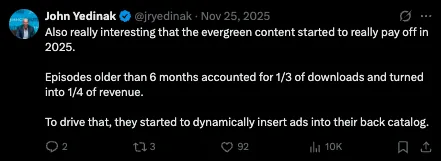
The recipe for timeless content appears to be extremely well-researched histories/interviews/profiles of interesting people or companies told/written in a narrative-style story by engaging hosts/writers.
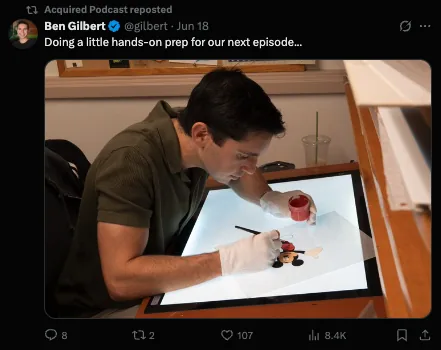
This kind of content can sometimes last for hours, which is almost ridiculous to consider in our instant-gratification society. Who the fuck has time to listen to a 4-hour podcast?
The answer is lots and lots and lots of people, but they don’t consume it all at once.
They consume it like a book, reading a few pages or a chapter at a time, inserting a bookmark, and picking it back up later. Flight? Road-trip? Workout? Commute?
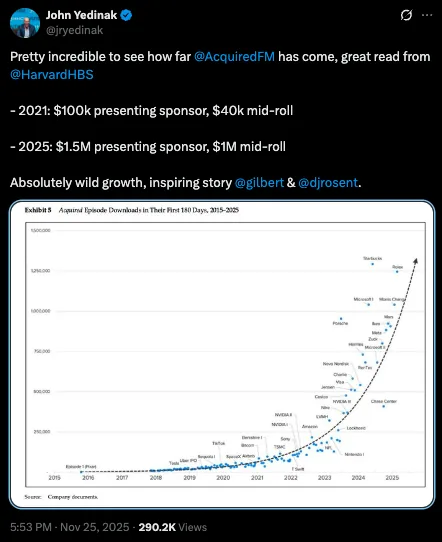
People look forward to multiple sessions spent consuming single episodes in the same way they used to look forward to the next episode of a series like True Detective (remember when episodes were released weekly?). Which explains Acquired’s enormous ad revenue success as well.
So what unifies these seemingly opposite forms of content (other than quality)?
- Short-form consumption, no matter the production
- Perspective
Short-form consumption
Both timely and timeless content ultimately get consumed as variable-length short-form content. Livestreaming gets cut into clips, and long-form gets consumed in chunks as desired by the consumer.
Having an eye to how content might get shortened is a critical skill moving forward.
Perspective
Samir, from the inimitable Colin & Samir show, articulated this extremely well on TBPN (of course):
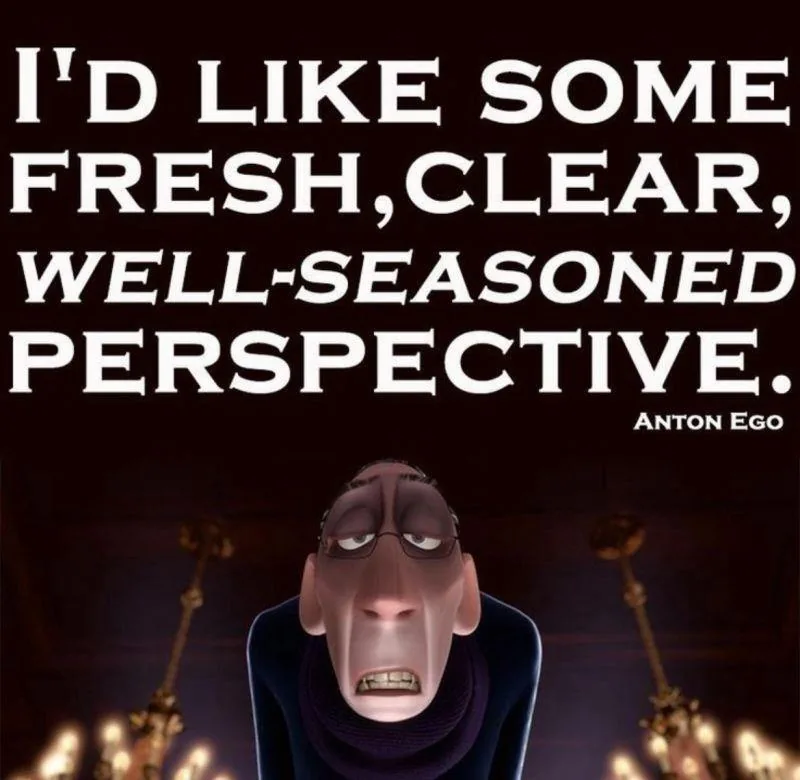
I think this next era that we're in and the biggest shift that's happened in YouTube over the past year has been a shift towards perspective…
Information and attention void of perspective is just completely uninteresting.
I think we can access information now very easily through LLMs, through search, through anything… Perspective I think is the thing that makes it stick in your brain.
Alex Danco of a16z put it well in a brilliant post on prediction and postmodernism.
We may soon arrive in a world where intelligent machines are conceiving, driving, and implementing a lot of our material progress. They’ll be making scientific discoveries, recursively designing new robots, and who knows what else. That’s a great thing. We’ll take all the progress we can get.
But it is essential that people in the world feel like they have a stake in the system; like they’ve contributed to our shared sense of progress. And I believe Predictions, as a movement, are the answer to our postmodern malaise. They give us something to do.
I see no better explanation for the rise of speculation, gambling, and public prediction in the last ten years of popular culture than as a mass revolt against the numbing apathy of late postmodernism. And even though I find some of it uncouth and crass, I don’t see it as a regression: it’s a step forward, in self-discovery. We have a new way to think about our purpose in the world: we create order in the universe by contributing information. And in the past few years, we’ve discovered the extent to which it’s a shared purpose; perhaps a universal one. I couldn’t imagine something more optimistic if I tried.
Uhh…so what’s the point?
The point is this all has to inform whatever content you’re producing, be it corporate, personal, or on behalf of someone else.
Tune in next week as we explore the implications of “timely” or “timeless” content on comms strategies for enterprises big and small.
FAQ
What's the difference between timely and timeless content?
Timely is effectively real-time — shows like TBPN dissecting events as they happen, impossible to do part-time. Timeless is deeply researched narrative — Founders, Acquired, Colossus — that people can return to years later. The trick is both get consumed the same way: in chunks, on the consumer's schedule.
Why do clips matter more than the live audience?
Because almost nobody watches live — the daily stream is the table-stakes discipline that produces the clips, which get published wherever the audience actually lives and feed the algorithms daily content. If the live audience mattered more, OpenAI wouldn't have bought the franchise.
What does "perspective" mean for a content strategy?
Information is now free — LLMs and search hand it to anyone. Perspective is the point of view that makes information stick in someone's brain, and it's the thing your content has to supply whether it's corporate, personal, or on behalf of someone else.